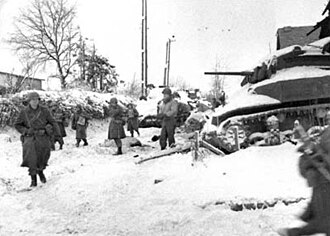
Corporal William Hayes of the 101st Airborne was fighting in Bavaria in April 1945 when his unit was pinned down by a German machine gun nest in the village of Berchtesgaden. During the assault on the position, Hayes found a young German soldier lying in the street with a gunshot wound to the stomach.
The German soldier was approximately 18 years old. He was holding a photograph of his family in one hand and a letter in the other. The letter was addressed to his mother, and although Hayes could not read German, the photograph told the story: a mother, a father, and two younger siblings. The soldier had clearly known he was going to die.
Hayes carried the German soldier to a field hospital, where the boy was treated and survived. A few weeks later, after the war was over, Hayes visited the soldier in the hospital. The soldier, whose name was Klaus, told Hayes that he had been drafted into the Wehrmacht six months earlier and had never wanted to fight. He was a schoolteacher from a small village and had been ordered to defend a position that should never have been defended.
After the war, Hayes returned to Berchtesgaden to visit Klaus family. He walked to the village, found the farmhouse, and knocked on the door. Klaus mother opened it. Hayes did not speak German. She did not speak English. But he handed her the letter that Klaus had been carrying when he was wounded. She read it, put her hands on her face, and began to weep.
Hayes stayed the night in the farmhouse. He ate dinner with Klaus family, and Klaus mother showed him a photograph of Klaus that had been taken in 1943, before the draft. She pointed to the photograph, then to a chair, then to her heart. She did not need words.
Hayes and Klaus corresponded for the rest of their lives. Klaus became a schoolteacher, as he had planned before the draft. Hayes became a police officer in Ohio. They visited each other every five years until Hayes died in 1998. Klaus attended his funeral and stood in the front row, the only German in a room full of Americans.